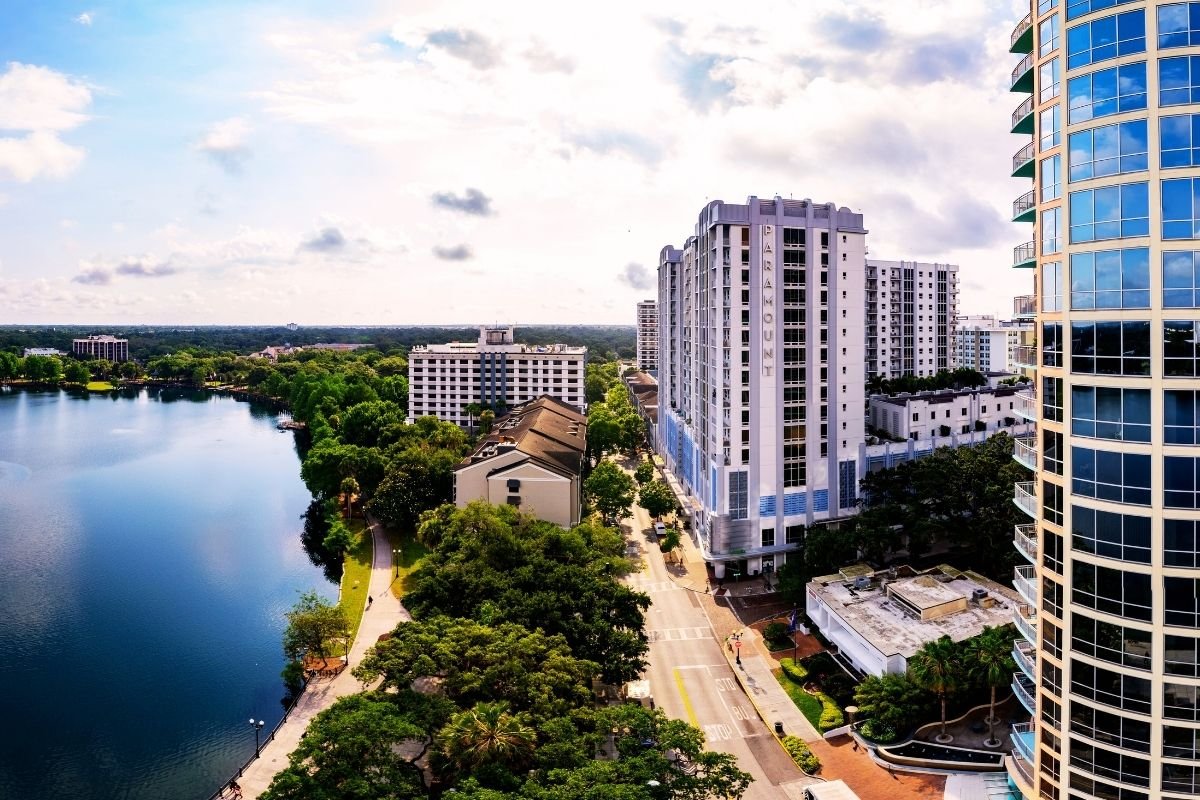
If you’re searching “Best Area to Stay in Orlando Without a Car”, you’re not really asking for a pretty neighborhood.You’re asking one dangerous question:
“Where can I sleep so my trip doesn’t collapse into paid repairs?”
Because Orlando without a car is not “impossible.” It’s fragile.
One wrong hotel base turns every day into a chain of fixes: a rideshare to start the morning, another to connect zones, another because heat slows you down, then a “quick meal” because you’re too tired to keep moving. None of it feels big in the moment. Together, it becomes the expensive feeling.
Quick answer: The best area without a car is the base that matches your trip’s core (theme parks vs city days vs mixed) and keeps you inside one tight zone most days. Orlando gets expensive when you cross the city blindly and solve movement with repeated rideshares.
Pick your base in 10 seconds:
- Best for Disney/Universal-heavy trips: Theme Park Corridor
- Best for a walkable “real day” without paid fixes: Downtown (Lake Eola base)
- Best for tourist atmosphere with tight control: International Drive (time-capped blocks)
TripsCity rule: In Orlando, you don’t control cost by finding the cheapest hotel. You control cost by choosing the right base cluster so you don’t pay to “repair the day.”
How we judge a no-car base (3 signals): walkable reset (you can function without a paid fix), zone integrity (you’re truly inside the zone you picked), and transport clarity (no “maybe shuttle” planning).
Snippet-ready: This guide gives you a clean no-car decision system: the 3 no-car travel styles, the best base areas for each style, a decision table, red flags (what looks good online but fails in real life), and copyable day templates that stop rideshare spending from stacking.
Table of Contents
- How to use this guide in 60 seconds
- Base clusters (the no-car reality)
- The 3 no-car styles that actually work
- Fast picks (pick one path)
- Decision table
- MCO → your base (no-car)
- Official sources (verify once)
- Deep breakdown of each base
- No-car hotel red flags
- Copyable no-car day templates
- 90-second hotel test
- When no-car Orlando fails
- The no-car day system
- Optional booking shortcuts (only if you want)
- Quick checklist
- TripsCity tools
- FAQ
How to Use This Guide in 60 Seconds
- Step 1: Pick your reality: Theme parks core OR City days OR Mixed trip.
- Step 2: Choose ONE base cluster that matches that reality (don’t “average” it).
- Step 3: Commit to ONE transport style for the day (shuttle OR trolley/transit OR rideshare). Avoid mixing styles all day.
- Step 4: Add ONE controlled add-on (time-capped). Two far zones in one day = a leak day.
- Step 5: Use an exit trigger: heat, queues, tired legs, spending drift—exit clean before you start buying comfort.
Orlando Without a Car: Think in Base Clusters (Not “One City”)
Most first-timers fail Orlando because they plan it like a walkable “center.” Orlando isn’t built like that. It’s a city of zones — and the cost isn’t only inside zones. It’s in the jumps between them.
TripsCity model: Pick a base cluster, then cap most days inside it. That’s how “no-car Orlando” becomes manageable instead of expensive.
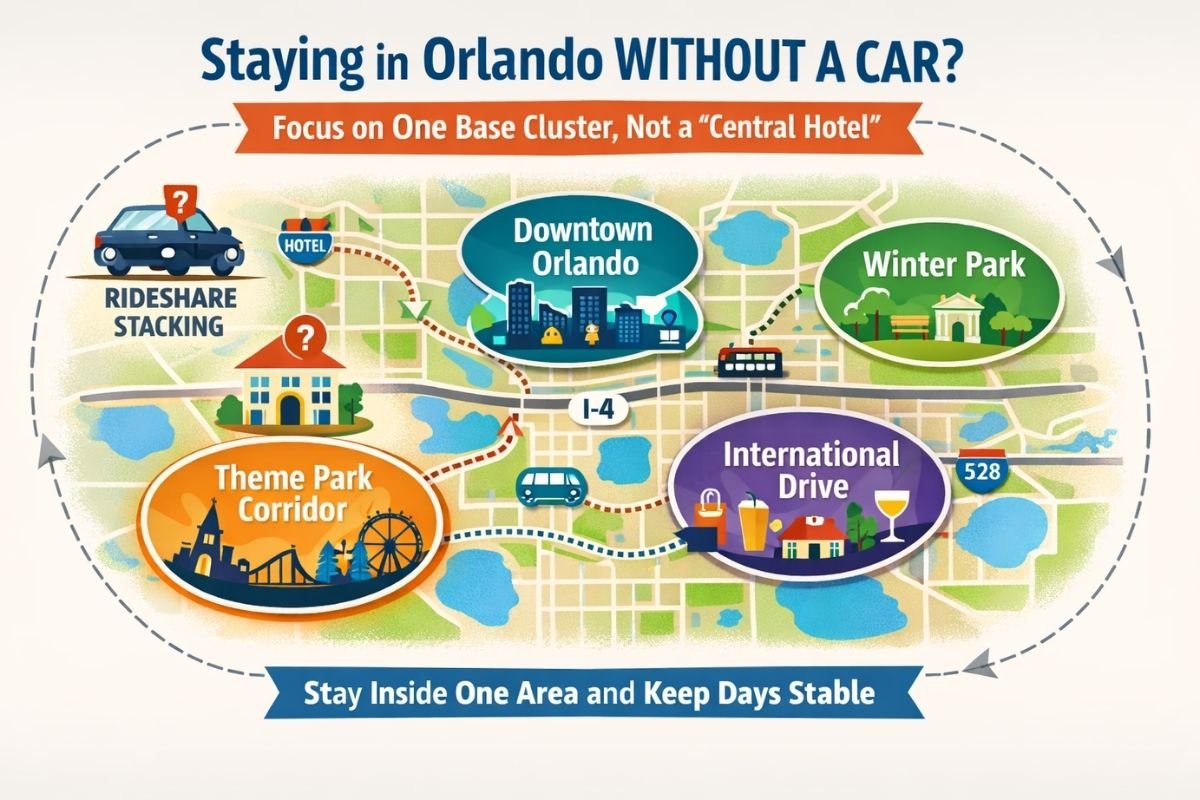
Orlando without a car works when you live inside one base cluster most days — not when you chase “a central hotel.”
The 3 No-Car Styles That Actually Work in Orlando
Without a car, you’re not choosing a neighborhood — you’re choosing a movement system. There are only three styles that consistently work:
- Style A — Corridor living (Theme parks): Stay close to Disney/Universal days so your heavy days stay short and you avoid transport stacking.
- Style B — I-Drive contained zone: Treat International Drive as an atmosphere base, but run it with strict time-caps so it doesn’t turn into slow spending.
- Style C — Real city texture (Downtown / Winter Park days): Build at least one walkable “human day” where the plan doesn’t require paid fixes to function.
What fails: trying to do all three from a random “middle” hotel. For no-car visitors, the “middle” is usually just distance in every direction.
Fast Picks: Best Areas to Stay in Orlando Without a Car (Pick One Path)
Best base: Theme Park Corridor (Disney / Universal area)
Why it works: You reduce the “double-cost day” (tickets + long transport fixes). Most movement becomes short rides/shuttles.
Rule: Park day = one big day. Add-ons must be time-capped, not “let’s do another zone too.”
Stability move: If you have ONE must-do paid day, lock that anchor early so the rest of the week stays calm:
compare ticket day options.
Best base: Downtown Orlando (and run Winter Park as a separate calm day)
Why it works: Your day can exist with walk loops + short controlled moves, so you don’t pay to keep moving.
Rule: One walkable anchor + one nearby add-on + buffer + exit trigger.
Best base: International Drive (I-Drive)
Why it works: It can function as a contained zone if you run it with strict time caps and avoid boredom spending.
Rule: Set a hard cap (60–120 minute blocks). When you start spending to “create entertainment,” you exit.
TripsCity warning: The most expensive no-car Orlando move is choosing a base that forces multiple paid fixes every day (rideshare stacking) while still being far from your main anchors.
Decision Table: Choose the Best No-Car Base (No Guessing)
| Your trip goal | Best base area (no car) | Why this base wins | What you must avoid |
|---|---|---|---|
| Theme parks are 70–100% of the trip | Theme Park Corridor | Keeps heavy days short + reduces transport fixes | Stacking extra zones after a park day |
| You want calm, walkable “real day” travel | Downtown (plus Winter Park as a separate day) | Walk loops + controlled add-ons = fewer paid repairs | Choosing a “cheap” hotel far from walkability |
| You want tourist vibes + many options close by | International Drive | Contained atmosphere zone if time-capped | Endless wandering that becomes micro-spending |
| Mixed trip (parks + city texture) | Pick ONE primary base (parks corridor OR Downtown) | A strong base prevents daily transport stacking | Trying to “average” location and ending up far from both |
MCO → Your Base Without a Car (One Decision, Then Stop Thinking)
Most no-car trips lose stability on Day 1. You land tired, weather hits, and the first “fix” becomes the pattern.
Simple rule: Pick one controlled arrival method, do it once, then stop thinking about transport until tomorrow.
- MCO → Theme Park Corridor: Hotel shuttle (only if clearly scheduled) or one direct transfer. If you want a clean start:
direct airport transfer. - MCO → I-Drive: A direct transfer is usually the cleanest for first-timers; then run I-Drive in time-capped blocks.
- MCO → Downtown: A direct transfer keeps Day 1 stable. Transit can work, but it’s slower than visitors expect and should not be your “tired arrival” plan.
No-Car Transport: Verify Once (Official Sources)
Transport info changes. Don’t overthink it — verify basics once using official pages, then move on with your plan:
- MCO Ground Transportation (official)
- I-Ride Trolley (official)
- MCO local bus pickup details (official)
Best Areas Without a Car: What Each Base Solves (And What It Breaks)
The phrase “best area” hides the real truth:
There is no single best base in Orlando without a car. There is only the base that matches your trip’s shape.
Base #1: Theme Park Corridor (Disney / Universal Area)
Who this base is for: Theme parks are the core (or the emotional center) of your trip.
Best for: Disney/Universal-heavy trips where you want heavy days to stay short and predictable.
Trade-off: Less “walkable city texture” — and you’ll be tempted to add extra zones after a park day.
What it solves: The #1 no-car failure: the double-cost day (tickets + long transport fixes).
What it breaks (if you choose it for the wrong trip): If your real goal is “walkable city texture,” this base can feel like you’re living in a functional bubble. You’ll be tempted to “add one more zone” each day — and that’s how cost leaks start.
Micro-areas that work (names people actually search)
- Disney focus: Lake Buena Vista / Disney Springs area
- Universal focus: Universal Blvd / near Universal Orlando area
- Mixed parks: stay corridor-tight instead of chasing a “middle” point
How to run this base correctly (no-car rules):
- Park day = one big day. Don’t stack a second major zone after it.
- Choose one transport style for the day: hotel shuttle OR one direct rideshare (not both all day).
- Time-cap your add-on: 60–120 minutes max.
Hotel selection tip (no-car proof): Don’t book a corridor hotel because it says “close.” Book it because it reduces daily fixes. If you want a clean comparison view, keep your shortlist corridor-only:
Theme Park Corridor hotels.
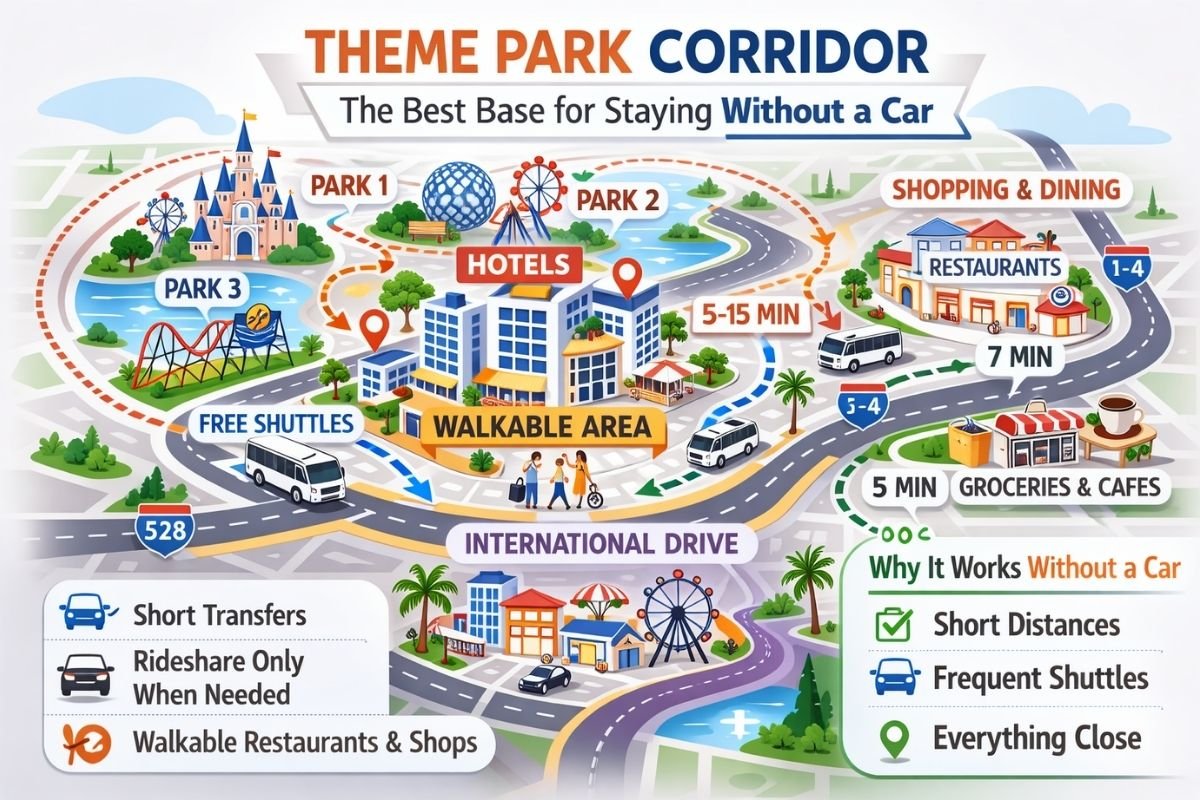
Theme Park Corridor works without a car because it makes heavy days short and controlled — not because it’s “central.”
Base #2: International Drive (I-Drive)
Who this base is for: You want tourist atmosphere and lots of nearby options — but you still want control.
Best for: Tourists who want variety close by and can follow strict time-capped blocks.
Trade-off: Easy to drift into slow wandering + micro-spending if you don’t enforce caps.
What it solves: The “we want options close by” urge. I-Drive can feel convenient because it’s designed for tourists.
What makes it dangerous without a car: I-Drive becomes expensive when it turns into slow wandering with no time boundary. When you’re bored or tired, you start spending to create momentum. That’s not a moral failure — it’s a planning failure.
Micro-areas that work
- South I-Drive: around Sand Lake Rd (often easier to keep days contained)
- Mid I-Drive: closest to dense trolley stops (reduces “first rideshare” starts)
- North I-Drive: works only if your plan is truly I-Drive contained (no daily cross-city jumps)
How to run I-Drive correctly (the cap strategy):
- Work in blocks: 60–120 minutes, then exit clean.
- Choose ONE goal per block: a short walk loop + one clear moment.
- Use the boredom alarm: the moment you start spending to manufacture fun, you leave.
Hotel selection tip (no-car proof): If your base is I-Drive, avoid “almost I-Drive” hotels that force you to rideshare just to reach the contained zone. If you want a tight shortlist:
I-Drive hotel options.
Base #3: Downtown Orlando
Who this base is for: You want at least one day (or multiple days) that feels like a real, human travel day — not a transport puzzle.
Best for: Travelers who want a walkable “reset day” where the plan can function without paid fixes.
Trade-off: If parks are most days, transfers can get long and the week becomes fragile fast.
What it solves: the “we’re spending money just to keep moving” problem. Downtown is where Orlando stops feeling like an endless driving map. The win isn’t that everything is free — it’s that your day doesn’t require constant paid repairs to function.
What it breaks (if you choose it for the wrong trip): If you’re doing theme parks almost every day, Downtown can create repeated long transfers. That’s not automatically wrong — it just becomes fragile fast.
Micro-areas that work
- Downtown / Lake Eola area: best “walkable anchor start” for no-car visitors
- Thornton Park (near Lake Eola): adds texture without needing distance
Hotel selection tip (no-car proof): Downtown only works if your hotel lets you start walking without ordering a rideshare immediately. If you want to compare Downtown options with that lens:
Downtown Orlando hotels.
Winter Park: Best as a “Calm Day” (Not Always the Best Base)
Who Winter Park is for: Travelers who want one calm, scenic day that feels “real” without needing a big-ticket anchor.
The TripsCity way to use Winter Park: Run it as a separate day from your main base. It’s valuable because it stays calm. The moment you try to “make it bigger” by stacking another far zone, it loses its magic and costs more.
Micro-areas that work
- Winter Park / Park Ave: the clean “calm day” loop
- Central Park area: easy reset without forcing distance
No-Car Hotel Red Flags (What Looks Good Online But Fails in Real Life)
These are the traps that destroy no-car trips — even when the hotel price looks “smart.”
- Red flag #1: “Close to everything” language. Orlando isn’t one center. “Close to everything” usually means not close to your actual anchors.
- Red flag #2: “Shuttle available” with no details. Some shuttles run limited times, limited routes, or require booking. If the shuttle isn’t clear, treat it as a bonus — not your plan.
- Red flag #3: You must rideshare just to reach the zone you wanted. Example: booking “near I-Drive” but needing rideshare to get to I-Drive itself. That’s instant stacking.
- Red flag #4: No walkable reset nearby. Without a park loop / calm streets / basic essentials, your day gets repaired with spending when fatigue hits.
- Red flag #5: Your base forces two far transfers on most days. Two far jumps per day without a car is almost always the budget leak engine.

If your hotel triggers daily rideshare stacking, it’s not a “cheap base” — it’s a leak base.
Copyable No-Car Day Templates (So You Don’t Pay to Repair the Day)
These templates are designed to stop the two biggest problems:
- Transport stacking (multiple paid fixes)
- Spending drift (buying comfort when the plan collapses)
Template A — Theme Park Day (Corridor Base)
- Morning: One direct move to the park (shuttle OR one rideshare). No “extra stop.”
- Midday buffer: A planned slow block (rest, cool-down). This prevents impulse spending from fatigue.
- Exit rule: When the day starts feeling fragile (crowds, heat, legs), you exit clean.
- Evening add-on (optional): 60–90 minutes max, near your base only.
Template B — Downtown “Walkable Anchor” Day
- Anchor: One complete walk loop (90–150 minutes).
- Add-on (choose ONE): a nearby texture loop OR a calm green reset.
- Buffer: Sit + cool down + decide the next step while you’re still stable—this prevents “comfort spending.”
- Exit trigger: the moment you think “let’s jump to another zone real quick,” stop.
Template C — I-Drive Atmosphere Block (Time-Capped)
- Cap: 60–120 minutes.
- Goal: one simple loop + one clear moment (photo / view / short stop).
- Boredom alarm: if you feel bored and start buying entertainment, you exit.
Template D — Weather / Heat Swap (Plan Doesn’t Break)
- When rain hits: switch to short loops + indoor-friendly blocks inside your same zone.
- When heat hits: shorten distance, add a rest buffer earlier, and cap the day sooner.
- Rule: You don’t “fix” weather by adding distance. You swap the plan without changing zones.
Why this matters: Most Orlando budget leaks happen on weather days — because people start paying to make the day feel okay again.
The 90-Second Hotel Test (No-Car Proof)
Before you book anything, run this fast test. It’s designed to catch the “looks close online, fails in real life” trap.
- Test 1 — Start-of-day test: Can you start your morning without ordering a rideshare immediately?
- Test 2 — Reset loop test: Is there a simple walkable reset nearby (park loop / calm streets / basic essentials)?
- Test 3 — Zone integrity test: Does this hotel keep you inside the zone you actually want (corridor / I-Drive / Downtown)?
- Test 4 — Shuttle reality test: If you’re counting on a shuttle, is it clearly described (times, destination, frequency), or is it just “shuttle available” marketing?
- Test 5 — Two-jump rule: Will you be forced into two far transfers on most days? If yes, that base will leak money fast.
TripsCity decision: If you fail two of these tests, it’s not a no-car base. It’s a “repair base.”
When Orlando Without a Car Doesn’t Work (Be Honest Early)
No-car Orlando can be clean. But it fails in predictable scenarios.
- If you plan to cross zones daily (parks + Downtown + Winter Park + I-Drive all in one week, constantly mixing), you’ll create transport stacking.
- If you have multiple early starts (very early park entries + far hotel), you’ll default to rideshares more than you expect.
- If your group has low walking tolerance and your base has no reset loop, you’ll “buy comfort” all day.
Clean alternative (still not “salesy”): If you already know your trip shape is scattered, your best “cost control” move isn’t chasing a cheaper hotel. It’s making the trip less fragile (either by changing the base or changing the daily structure).
The No-Car Day System (So You Don’t Pay to Keep Moving)
Here’s the system that makes this whole guide work:
- One base cluster (your home zone)
- One daily anchor (the reason you left the hotel)
- One controlled add-on (optional, time-capped)
- One buffer block (heat, queues, tired legs)
- One exit trigger (leave before spending drift starts)
Translation: You don’t need a perfect plan. You need a plan that stays stable when reality happens.
A no-car Orlando day stays cheap by staying stable: one zone, one anchor, one buffer, one exit.
Optional Booking Shortcuts (Only If You Want)
In Orlando, bookings aren’t about “more stuff.” They’re about protecting the day.
- If parks are your core: the clean move is to lock one main paid anchor early so you don’t spend the week repairing the plan around uncertainty:
compare ticket day options. - If you’re choosing a hotel base: don’t browse the whole city. Browse inside your chosen cluster only (that’s how no-car stays controlled):
Theme Corridor stays / I-Drive stays / Downtown stays. - If you want one add-on without turning the week into a paid marathon: choose ONE controlled add-on and cap it:
see one time-capped add-on.
Quick Checklist (Before You Lock Your Base)
- I chose ONE base cluster (Theme Corridor OR I-Drive OR Downtown).
- I can start at least some mornings without ordering a rideshare immediately.
- My base has a walkable reset loop nearby (so I don’t buy comfort all day).
- My days don’t require crossing zones daily.
- If I’m counting on a shuttle, it’s clearly scheduled (not vague “available”).
- I have an exit trigger (heat, queues, tired legs, spending drift).
TripsCity Tools
Free/low-cost stabilizer day (no-car friendly):
Things to Do in Orlando for Free
Cost logic behind “why Orlando drains budgets” (the leak system):
Is Orlando Expensive for Tourists in 2026? Real Costs
FAQ: Best Area to Stay in Orlando Without a Car
What is the best area to stay in Orlando without a car for first-timers?
The best base is the one that matches your trip’s core. If theme parks are the main reason you’re coming, the Theme Park Corridor is the lowest-risk no-car base. If you want calmer “real days,” Downtown works best when your plan stays inside that zone.
Where to stay for Universal without a car?
Stay in the Theme Park Corridor with a Universal focus (around Universal Blvd / near the Universal area) so your heavy days don’t require repeated long transfers. The no-car win is reducing daily fixes.
Where to stay for Disney without a car?
Stay in the Theme Park Corridor with a Disney focus (Lake Buena Vista / Disney Springs area). It keeps park days short and controlled and reduces the double-cost day effect.
Is International Drive a good place to stay without a car?
It can be, if you run it as a contained zone. I-Drive fails when you treat it like an endless hangout area with no time caps, because boredom + fatigue triggers spending drift.
Is Orlando public transport reliable for tourists?
It can work if you stay inside a zone and plan in blocks (not “cross the city all day”). It’s usually slower than visitors expect, so the right base matters more than the perfect route.
What’s the biggest mistake no-car visitors make in Orlando?
Trying to “average” location and pick a random middle hotel. Orlando has no true tourist middle without a car. The middle usually means you pay for rideshares in every direction.