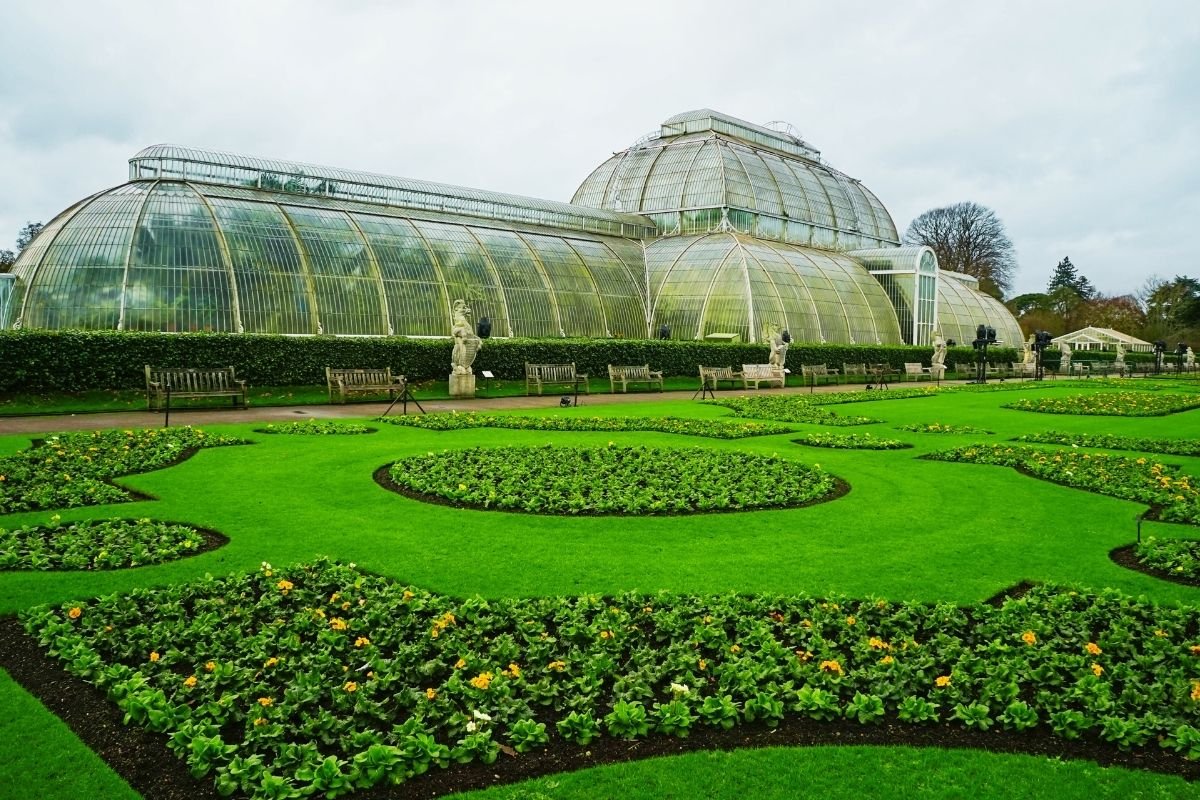
Last updated: February 2026 — refreshed for Kew Gardens seasonal opening hours, current ticket bands, transport access notes, and live closure planning.
If you’re searching for a Kew Gardens visitor guide, you’re not really searching for “a beautiful garden.”
You’re searching for a day that feels easy in London.
Because here’s the quiet truth: Kew is not hard… but it is big. And “big” is where most tourists lose time without noticing.
They arrive late. They wander. They chase the wrong glasshouse first. They walk past the best sights when they’re still fresh… and end up using their best energy on long, empty connectors.
This guide is built to stop that.
It gives you:
- A simple ticket + timing strategy (so you don’t overpay or arrive at the wrong moment)
- The best sights with “why they matter” (not a random list)
- An easy route that reduces backtracking
- Practical rules tourists actually need (bags, step-free notes, closures, kids, weather)
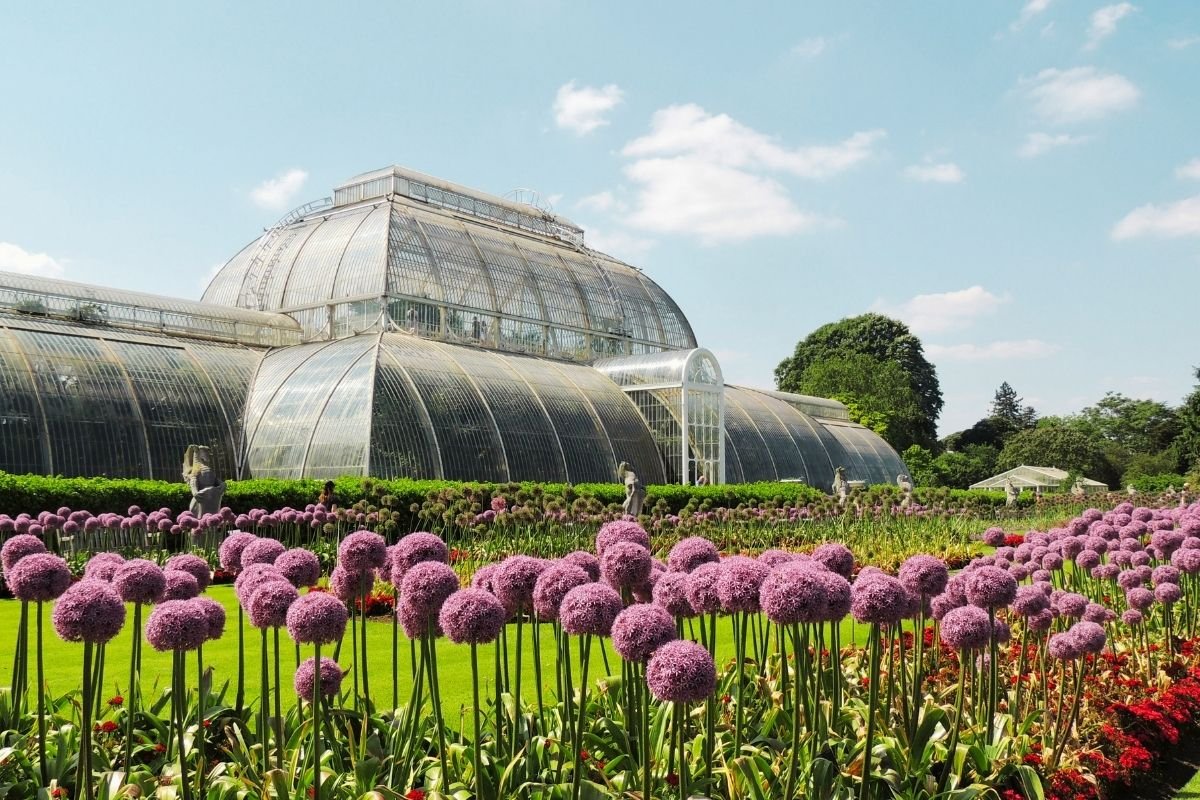
Palm House across the water: the iconic “you made the right choice” moment—best early, before the crowds stack up.
Fast Picks (Read This in 30 Seconds)
- Best arrival time: Enter near opening. Kew feels spacious early; it feels slower once families + groups stack up.
- Best gate for first-timers: Victoria Gate (most direct for the “icon route” + close to key anchors). Kew Gardens station is ~500m from Victoria Gate. (Official “Getting here”)
- Best “must-see” trio: Palm House → Temperate House → Treetop Walkway (then choose a 4th based on your style).
- How long you really need: 3–4 hours is the “good” visit. 5–6 hours is “full” without rushing. A whole day is only worth it if you’re adding kids zones + galleries + palace/pagoda pacing.
- One planning rule: Do glasshouses first (weather-proof + wow factor), then open landscapes last (when you’re happy to wander).
Tickets (2026): What to Buy, When, and Why
Kew tickets are seasonal (Peak vs Off-peak), and the most reliable way to avoid price surprises is simple: check the official ticket bands before you pick your date.
Check ticket availability for your date: Check ticket availability
Official ticket page (live prices): Tickets & Prices — Royal Botanic Gardens, Kew
What’s on (exhibitions/events for your date): What’s on at Kew Gardens
Orchids note (Feb–Mar): Orchids is included with entry, but requires a timed slot. If you’re visiting in February–early March, don’t build your route around the Conservatory until you confirm the timed-ticket rules for your date.
Where the Orchids access rules appear (official): Kew publishes the Conservatory access notes during Orchids season inside the Planned closures & visitor notices page—check your exact date before you plan your “variety add-on.”
Ticket Snapshot (Core Visitor Prices)
| Season | Adult (Online) | Adult (Gate) | Child 4–15 (Online) | Child 4–15 (Gate) |
|---|---|---|---|---|
| Peak (Feb 1 – Oct 31) | £24 | £27 | £6 | £8 |
| Off-peak (Nov 1 – Jan 31) | £16 | £19 | £5 | £7 |
Donation note: Kew also shows “with donation” prices on the official page. The table above lists the standard online/gate prices without the optional donation.
After 4pm (seasonal): Between 1 May and 26 October, Kew sells an “After 4pm” ticket band (online and gate). Always confirm the exact price and date rules on the official ticket page.
Important: Prices can change, and Kew also offers other categories (young person/student, concessions, local residents, families). Always confirm on the official page before publishing or booking.
What your standard entry includes
- Access to the gardens and major outdoor areas
- Entry to the key glasshouses (when open) like Palm House / Temperate House
- Many seasonal exhibitions (included) — always check “What’s On” for the date you’ll visit
Optional extra: Kew Explorer land train
If your group has kids, a stroller, or anyone who hates long connectors, the land train can save the day.
- Price: Adults £5 / Children £2 (essential carers free)
- Where to buy: On site (typically from Stop 1 near Victoria Gate)
Service detail: Kew lists the land train as running daily from 11am, and a full loop typically takes around 30 minutes (always check the day’s service info on site).
Official info: Kew Explorer land train
Opening Times (2026): The “Last Entry” Trap
Kew’s opening times are seasonal. The key thing tourists miss is the difference between:
- Gate closing time
- Last entry time (often earlier)
- Attraction times (some glasshouses/cafés can run on their own timing)
Official opening & closing times (live): Kew Gardens opening and closing times
Typical February hours (check your date): In February, Kew lists the Gardens as 10:00–17:00 with last entry 16:00. Always confirm for your exact date on the official page.
February trap (gold detail): In February, Kew lists the glasshouses as open daily 10am–4pm — meaning they close earlier than the Gardens. Build your route with this in mind.
Treetop Walkway timing trap: In February, Kew lists the Treetop Walkway with a last entry at 15:45. Translation: do it before you drift into a long afternoon add-on.
Planning rule: Treat “last entry” as the real deadline. If you want a calm visit, arrive early enough that you’re not racing glasshouses in the final hour.
Planned Closures: Check Before You Commit
Kew occasionally closes gates or specific areas for maintenance, safety, weather, or long renovations. The smartest visitors check closures before they travel — not at the gate.
Official closures page: Planned closures & visitor notices
Example of why this matters: Kew may list temporary gate closures or key-area interruptions like:
- Waterlily House closed for renovation
- Children’s Garden ongoing essential maintenance (some areas may be closed)
- No lockers / no baggage storage facilities
Smart habit: If you’re aiming for a specific anchor (Conservatory, a gallery, a gate), check the closures page again on the morning of your visit—day-specific updates happen.
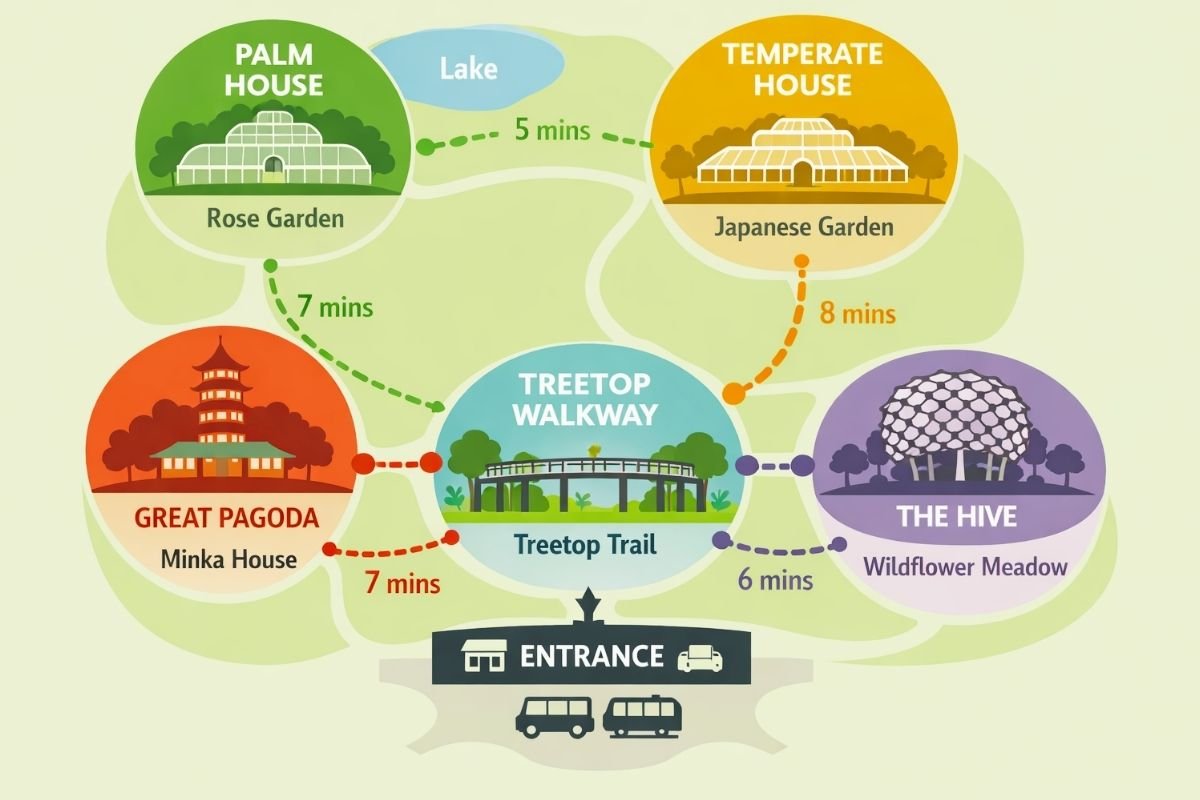
The easy loop route: a simple highlight path that stops backtracking—do glasshouses first, then choose one afternoon add-on.
How to Get to Kew Gardens (Tourist-Proof Options)
Official travel page: Getting here (gates, tube, train, bus, car)
By Tube / Overground (Most common)
- Kew Gardens station is about 500m from Victoria Gate and is in Zone 3.
- It’s served by the District line (Richmond branch) and the Mildmay line.
- Step-free note: Kew’s official travel page warns there is no level access from the westbound platform. If step-free matters, you may need to go one stop to Richmond and return to use the eastbound platform (which does have level access).
Before you travel: planned track works can affect the Richmond branch and Overground routes. Check: TfL planned track closures (PDF)
Official station info (accessibility): TfL — Kew Gardens station
By Bus (Good for families + low walking)
Kew’s official travel page lists several routes that stop near gates/stations. Use it as the source of truth because routes can change.
- Route 65 (near multiple gates)
- Route 110 (near Kew Gardens station / Elizabeth Gate)
- Routes 237 / 267 (near Kew Bridge station)
By Car (Only if you must)
Parking is limited and first-come, first-served. Kew’s official page currently lists:
- Kew Gardens car park (Ferry Lane, near Brentford Gate)
- Price: £9 per day (plus operational notes like closing shortly after the Gardens close)
Driving reality: Kew is outside the Congestion Charge zone, but London’s ULEZ rules may still apply depending on your vehicle—check the official TfL details: Ultra Low Emission Zone (ULEZ)
Always confirm the latest on: Getting here
One bag rule (tourist reality)
Kew’s official travel page states there are no lockers or baggage storage facilities in the Gardens. Translation: don’t arrive with suitcases and hope for a solution at the gate.
Best Sights at Kew (What’s Actually Worth Your Time)
Kew has enough “nice things” to fill 10 hours — but tourists don’t need 10 hours. They need anchors.
These are the anchors that consistently deliver the “I’m glad we came” feeling.
1) Palm House (The Icon)
This is your first high-impact stop. It’s immersive, warm, and photogenic — and it gives you that immediate “London disappeared” effect.
Official info: Palm House
Renovation planning note: Kew’s project page indicates renovation is expected to begin later, with time to visit before temporary closure; it also notes Waterlily House is currently closed for renovation. Always check closure updates before your date.
Project page: Palm House renovation project
2) Temperate House (The Cathedral)
Temperate House is the “awe” glasshouse. It feels like a botanical cathedral — huge, bright, and structured in a way that makes you slow down.
Official info: Temperate House
3) Treetop Walkway (The Perspective Shift)
If you want one experience that feels different from “walk + plants,” this is it. You get views, canopy-level perspective, and a clear moment of “we did something.”
- It’s about 18 metres above the ground
- It has 118 steps in total
- Strollers/buggies are meant to be left at ground level
- It can close in bad weather
Official info: Treetop Walkway
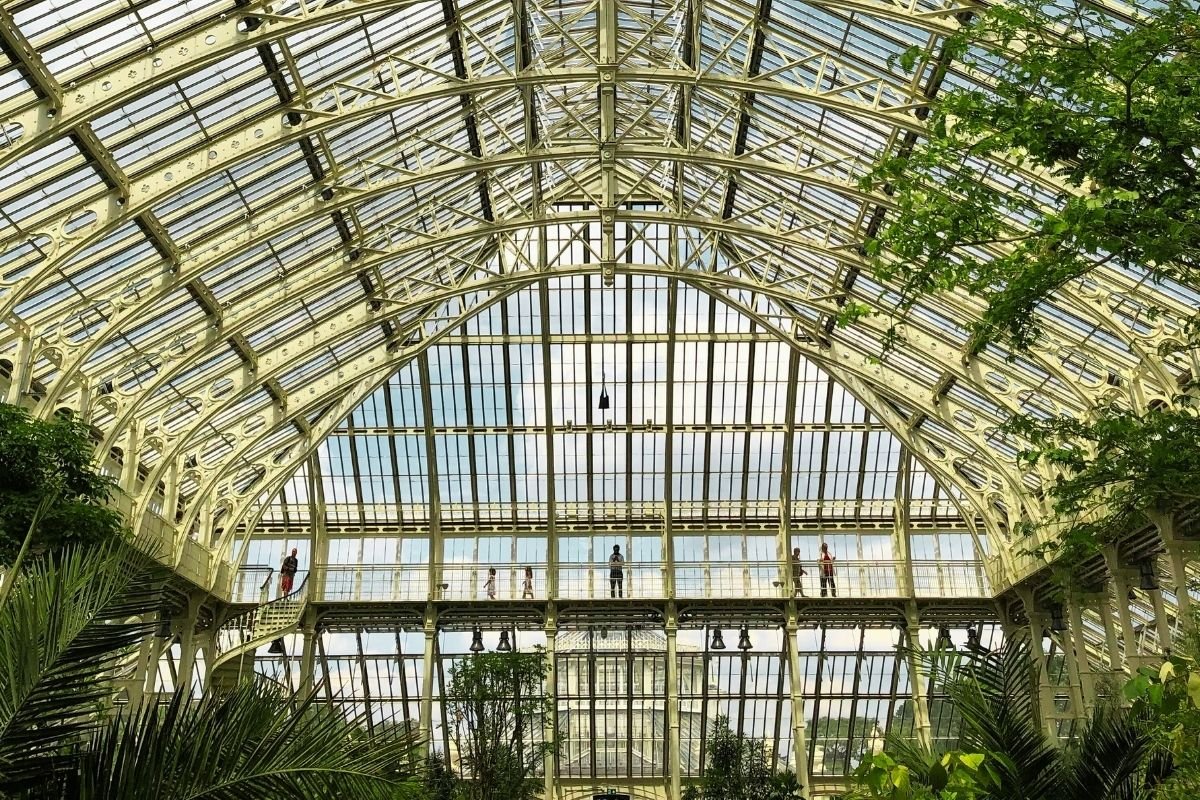
Temperate House inside: the “cathedral” of Kew—wide, bright, and worth slowing down for (especially on cold or rainy days).
4) Princess of Wales Conservatory (Choose this if you want variety)
This is the “many climates in one place” option — useful if your group wants a faster variety hit rather than one giant glasshouse mood.
February–early March 2026 trap (big): Kew lists the Princess of Wales Conservatory as closed until 6 February, then open for Orchids ticket holders only from 7 February to 8 March.
Planning rule: In Feb–early Mar, access may be restricted due to Orchids timed tickets—check planned closures before you build your route around this as your “variety add-on.”
Official opening times note: Always confirm attraction timings inside the main “opening and closing times” page.
Official reference hub: Opening & closing times (attractions)
5) Great Pagoda + Kew Palace (Choose this if you want history)
If your group wants a “London history” layer inside the nature day, this is the area that delivers it.
- Great Pagoda: A clear visual landmark and a “we did Kew” memory (even when you only do the exterior viewpoint).
- Kew Palace: Adds royal-history texture (check opening times because palaces can run differently from gardens).
As of February 2026: Kew lists Kew Palace, The Pagoda, and Queen Charlotte’s Cottage as closed until spring 2026. Always verify before you plan this zone as your main afternoon anchor.
Official attraction status hub (Kew): Opening & closing times (attractions)
Official palace timings (HRP): Kew Palace — opening & closing times (HRP)
Bonus anchors (only if you have time)
- The Hive (a modern, sensory landmark — especially good near golden hour)
- Marianne North Gallery (if you want “art inside nature”)
- Japanese Landscape / Bamboo Garden area (if you want a calmer, themed atmosphere)
The Easy Route (2026): The Loop That Saves Walking
This route is built for tourists who want the highlights without feeling like they “marched a park.”
Route Overview (4 to 5 hours, calm pace)
- Victoria Gate entry → grab a map + set your first anchor
- Palm House (first wow + photos while you’re fresh)
- Temperate House (the cathedral moment)
- Treetop Walkway (perspective shift + “activity”)
- Choose ONE afternoon add-on:
- History add-on: Great Pagoda + Kew Palace zone (only if open on your date; winter closures are common)
- Variety add-on: Princess of Wales Conservatory (Orchids season can restrict access)
- Kids add-on: Children’s Garden zone (check closures / maintenance first)
- Exit plan: If you’re tired, use the land train or walk back via the most direct path shown on the official map.
Time Blocks (So your day doesn’t drift)
| Time | Move | Why it works |
|---|---|---|
| 0:00–0:20 | Enter at Victoria Gate + orient | Stops wandering from stealing your best hour |
| 0:20–1:10 | Palm House | High impact early, weather-proof |
| 1:10–2:10 | Temperate House | Your “cathedral” anchor, best at calm pace |
| 2:10–2:40 | Treetop Walkway | Turns the visit into a memory, not just a walk |
| 2:40–4:30 | Choose ONE add-on zone | One clear choice prevents “do everything badly” |
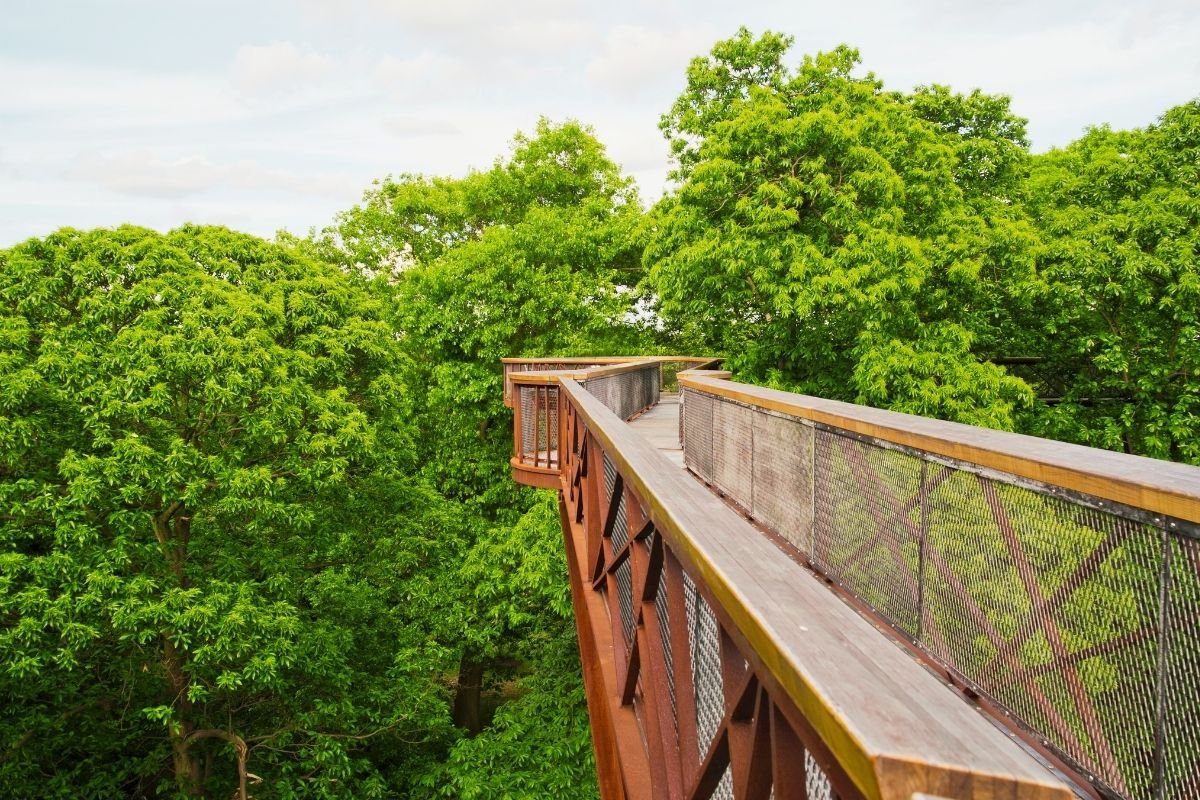
Treetop Walkway: the perspective shift that turns the visit into a memory—do it before late-afternoon last entry.
Routes for Specific Tourists (Choose the one that matches you)
If you only have 2.5 hours
- Palm House (45–60 min)
- Temperate House (45–60 min)
- Fast walk to one landmark photo stop (Pagoda viewpoint / Broad Walk area)
Rule: Do not attempt everything. Your goal is two anchors done well.
If it’s rainy or cold
- Start with Palm House
- Move to Temperate House
- Add conservatory / gallery time (only if open for your date)
- Use outdoor walking only as connectors between indoor anchors
If you’re visiting with kids
- Plan one “movement” moment: Treetop Walkway or Children’s Garden zone
- Use the land train if legs fade (it can rescue the second half of your day)
- Check closures for the Children’s Garden before promising it as the main highlight
Practical Rules Tourists Actually Need
1) Use the official map (don’t “guess” Kew)
Kew is a grid of attractions + long connectors. The map prevents “we’re close” mistakes.
Best source (always current): Maps of Kew Gardens (general + accessibility)
Optional PDF (secondary): Download the Kew Gardens map (PDF)
Accessibility info (practical details): Accessibility at Kew Gardens
2) Bags: travel light
Kew’s travel page states there are no lockers or baggage storage facilities in the Gardens. Bring what you can carry comfortably for hours.
Security note: Kew may conduct bag searches, and some items are explicitly prohibited (for example drones and professional camera equipment without a permit). Check: Prohibited items
3) Pets
Standard pets are not allowed. Only recognised assistance/service dogs are permitted. Plan accordingly (especially if you’re traveling with a pet).
4) Bikes, scooters, skates
Kew’s official “getting here” page states bicycles and various wheeled items (scooters, skates, etc.) are not allowed inside the Gardens. If you’re arriving by bike, use the racks at the gates.
Food, Breaks, and Toilets (So the day doesn’t crash)
Kew has cafés/restaurants and toilets across the grounds. The smartest move is to plan one deliberate break instead of “snacking randomly” and losing your route flow.
Tip: Use your break as a reset between anchors — for example, after Temperate House before your chosen add-on zone.
Official reference for facilities + timings: Opening & closing times (cafés/shops)
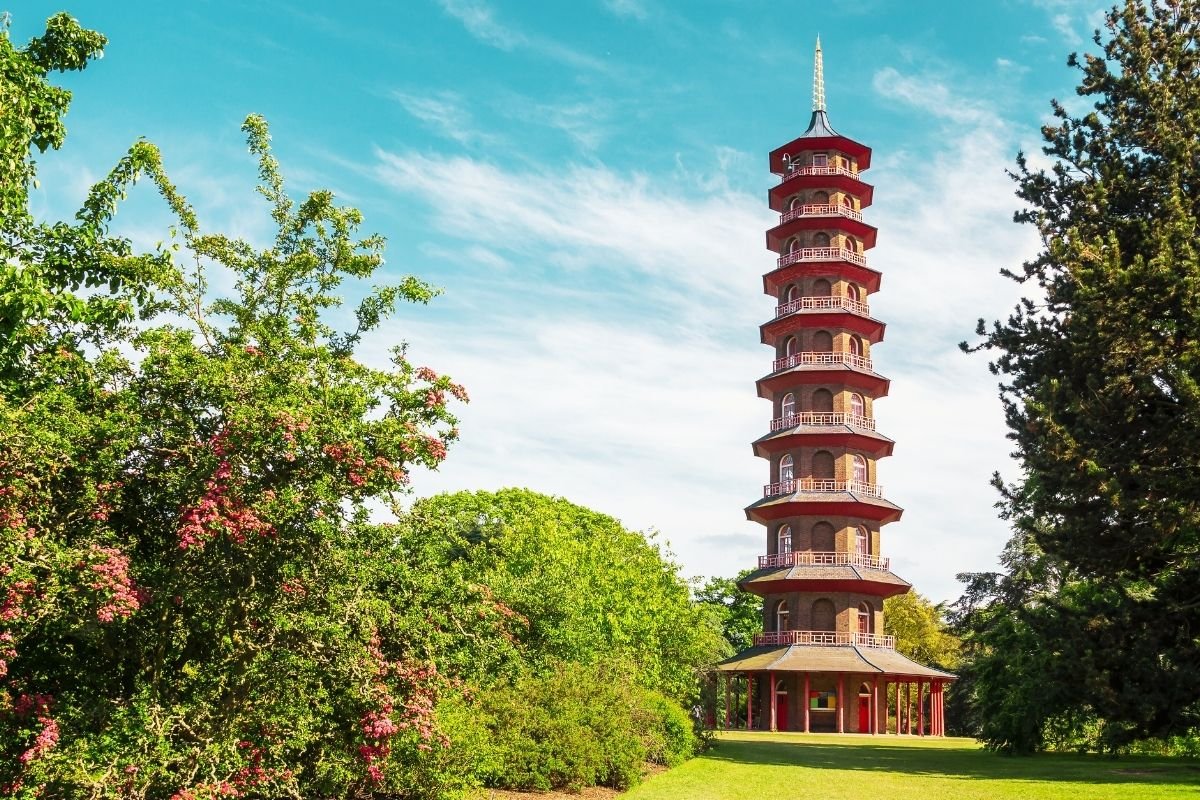
Great Pagoda viewpoint: a clean history anchor—even when you only do the exterior photo stop, it still feels like “classic Kew.”
Is Kew Gardens Worth It?
Yes — if you treat it as a planned half-day or a full calm day, not a random filler.
Kew is a UNESCO World Heritage Site, and it works best when you arrive with two ideas:
- Pick 2–3 anchors (not 12)
- Use an easy route so the gardens feel like a story, not a maze
UNESCO reference: Royal Botanic Gardens, Kew — UNESCO World Heritage
Related TripsCity Reads (Internal Links)
- London 7 Days Itinerary (2026): Day-by-Day Plan That Doesn’t Waste Time
- Free Things to Do in London England (2026): Cluster Plan That Saves Time
- Best Areas to Stay in London Near a Station (Easy Access)
FAQ (Kew Gardens Visitor Questions)
How long does it take to visit Kew Gardens?
Most tourists feel satisfied with 3–5 hours if they do the main anchors well. A full day is best if you’re adding kids areas, palace/pagoda time, galleries, and slow scenic walks.
What is the best route for first-timers?
Start at Victoria Gate → Palm House → Temperate House → Treetop Walkway → choose ONE add-on zone (History / Variety / Kids).
Do I need to book tickets in advance?
It’s strongly recommended to check the official ticket page and book online when possible, because prices differ online vs at the gate and some dates are busier.
Is Kew Gardens good in winter?
Yes — because glasshouses carry the experience even when the outdoor landscape is quieter. Just plan around earlier closing times and last entry.
Is Kew Gardens step-free?
Many paths are flat and accessible, but step-free access can vary by station/platform and by attraction. If this matters for your group, check the TfL station page plus Kew’s accessibility information before you travel.
Are pets allowed?
No — only recognised assistance/service dogs are permitted.