
Paris with kids can be an excellent family trip, but it works very differently from an adult sightseeing break. The Eiffel Tower, Louvre and Seine can all belong in the itinerary. The challenge is fitting them around shorter attention spans, meals, naps, stroller logistics and the fact that children rarely enjoy crossing the city simply to collect another landmark.
The most successful family days usually have one major attraction, one flexible activity and one proper recovery period. Add more only when everyone still has the energy for it.
The quick answer: Paris works well for most ages. Toddlers need shorter sightseeing blocks and realistic stroller planning. School-age children often respond well to boats, gardens, animals and attractions with a clear story. Older children can handle longer sightseeing periods, while teenagers usually have more patience for museums, neighborhoods, shopping and traditional landmarks.
| Child’s Age | What Usually Works Best | Main Planning Risk |
|---|---|---|
| 0–4 | Parks, short attractions, cruises, playgrounds and flexible meal stops | Stairs, naps and long museum visits |
| 5–9 | Boats, Eiffel Tower, animals, gardens and interactive experiences | Too much walking without play breaks |
| 10–13 | Landmarks, shorter museum visits, neighborhoods and hands-on activities | Repetitive sightseeing |
| Teens | Major museums, viewpoints, food, shopping and neighborhood exploration | Planning every hour for them |
TripsCity Insight: the best Paris family itinerary is rarely the one with the most attractions. It is the one where nobody needs an emergency taxi back to the hotel at 4 p.m.

Paris becomes much easier with children when sightseeing and recovery time are planned together.
How to Plan Paris With Kids Before You Arrive
Family travel in Paris becomes easier when you decide three things before building the attraction list: how often the children need rest, how much walking they realistically tolerate and whether returning to the hotel during the day is likely.
Those decisions affect almost everything else.
Choose a Hotel for Recovery, Not Just Sleeping
With children, the hotel is part of the itinerary. A location that looks slightly cheaper can lose its advantage if every morning starts with a long transfer or every evening ends with tired children walking another 15 minutes from the station.
This article does not need to decide which arrondissement is best for your family. That is a separate accommodation decision. Instead, use one rule here: the easier it is to return to your hotel, the easier it is to use midday breaks when you actually need them.
For the broader neighborhood comparison, use our Where to Stay in Paris guide.
Plan Paris With Kids Around Energy, Not Attraction Count
Adults often build a Paris itinerary by counting landmarks. Families should build it by counting demanding blocks.
An attraction requiring tickets, security, queues and concentrated attention counts as a demanding block even if the actual visit lasts only two hours.
After one of those blocks, the next activity should usually be easier: a garden, short walk, café, river cruise or neighborhood where you can change direction without losing a reservation.
Give Children Something to Anticipate
Not every part of the trip needs to be designed for children, but every day should contain something they understand.
A child may tolerate a museum more easily when they know a playground follows it. A longer walk becomes easier when the next stop is a boat or pastry. The goal is not bribery; it is giving the day a rhythm children can understand.
Paris With Kids: Transport, Strollers and Getting Around
This is one area where families should plan for the real city rather than the postcard version.
Paris has an extensive public transport network, but the historic Metro is not consistently step-free. That does not mean families should avoid it. It means you should not assume that every station or interchange will involve an elevator.
A compact stroller is generally easier to manage than a large travel system. Buses can be useful when they avoid deep stations or long corridors, while some RER and rail stations may offer easier access. Accessibility still varies by station and route, so check the exact journey rather than assuming one mode will always be simpler.
For current accessibility information, use the official Île-de-France Mobilités accessibility guidance.
For wider transport planning, see our Paris transportation guide.
Playgrounds Are Part of the Plan
A playground is not wasted sightseeing time. With younger children, it can be the activity that makes the next museum, meal or neighborhood walk possible.
Paris has play areas across many gardens and green spaces, which means you usually do not need to cross the city specifically to find somewhere children can move.
Use the City of Paris parks and gardens information to check what is close to the route you already plan to follow.
Family Safety Is Mostly About Avoiding Chaos
Normal big-city awareness still matters around crowded transport and major tourist attractions. Keep phones, wallets and bags controlled and teach younger children one simple station rule: stay beside the same adult and never rush through closing train doors.
For many families, however, fatigue creates more practical problems than crime. Tired children, overloaded bags and rushed station changes make it easier to lose things, miss stops or turn a small problem into a stressful one.
For broader scam and neighborhood advice, use our Paris Safety Guide.
Best Things to Do in Paris With Kids
The strongest family attractions are not necessarily places labelled “for children.” The better choices are experiences where adults still feel they are seeing Paris while children have something clear to watch, discover, climb, anticipate or understand.
Luxembourg Gardens: One of the Easiest Family Reset Stops
Luxembourg Gardens is easy to combine with a normal sightseeing day because it does not require another long indoor commitment.
Children can move, explore the play areas and watch the model boats when they are operating. Parents get benches, open space and a break from queues and museum behavior.
It fits particularly well when you are already around Saint-Germain-des-Prés or the Latin Quarter.
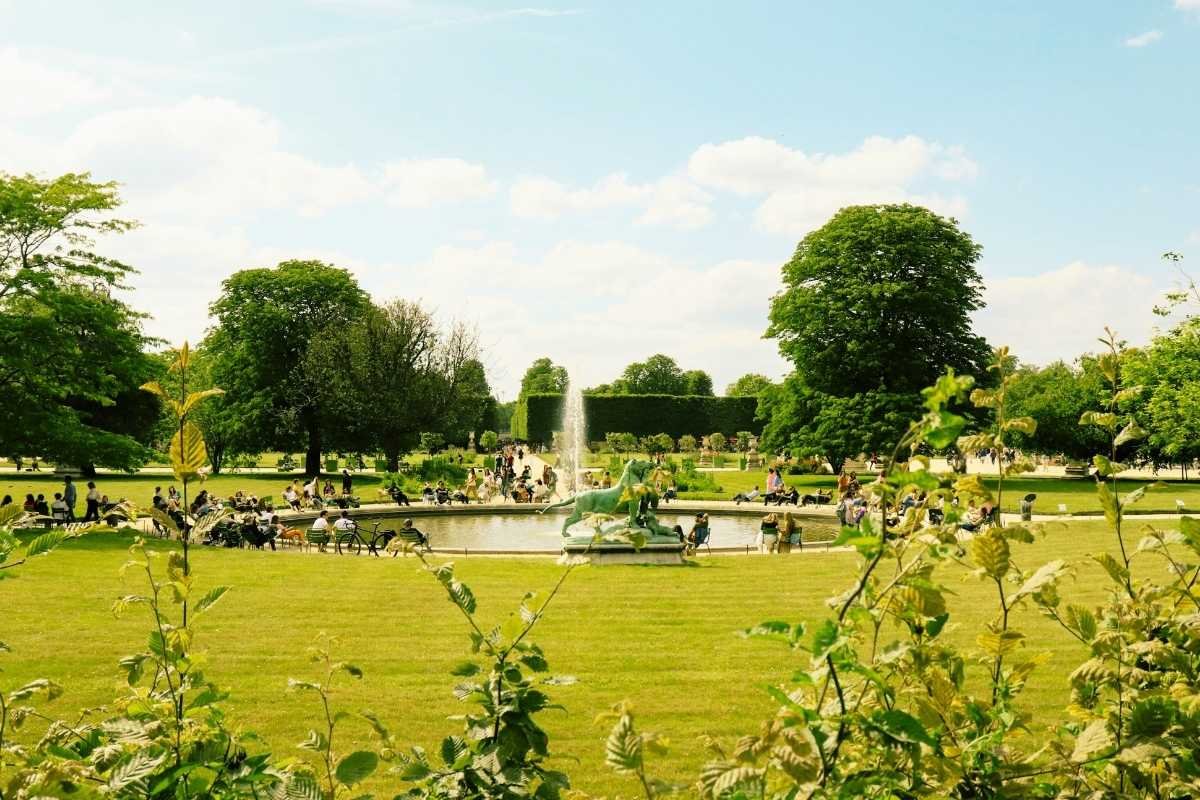
Luxembourg Gardens can turn the middle of a sightseeing day into a genuine recovery period.
The Louvre Can Work — Just Do Less of It
The Louvre can absolutely work with children. The mistake is expecting a family visit to look like an adult museum marathon.
The museum provides family-oriented activities and practical facilities, including options intended to make visits with babies and young children easier.
Choose one or two themes rather than trying to “see the Louvre.” Egyptian antiquities, sculpture or a small group of famous works gives children a clearer mission than endless galleries.
Visitors under 18 qualify for free museum admission, although the correct reservation may still be required depending on the visit.
Check the official Louvre family information and use our Louvre Museum guide for the wider visit strategy.
Use a Seine Cruise as Sightseeing and Recovery
A Seine cruise works unusually well for families because it solves two problems at the same time: children still see famous landmarks while everyone gets off their feet.
Instead of treating the cruise as another attraction to squeeze into the day, use it after several hours of walking. Bridges, boats and constantly changing views can also hold younger attention more easily than another static monument.

A Seine cruise can work as both sightseeing and a family rest block.
Read our Seine River Cruise guide. If a cruise fits your family schedule, you can also compare Seine cruise options.
Affiliate disclosure: TripsCity may earn a commission if you book through this link, at no additional cost to you.
Jardin d’Acclimatation for a Child-First Half-Day
Jardin d’Acclimatation makes sense when children need the itinerary to be about them for a while.
Instead of another monument, the visit offers rides, open space and play. It can be particularly useful after several days built mostly around traditional central Paris sightseeing.
The main trade-off is location. Do not add it casually between the Louvre and Notre-Dame. Treat it as a deliberate half-day rather than a quick stop.

A child-first attraction can restore balance after several traditional sightseeing days.
Animals and Parks When Museum Energy Runs Out
Parc Zoologique de Paris can work better than another museum when children need movement and a subject they already understand: animals.
Buttes-Chaumont gives families a different type of outdoor break. Its hills, paths and open views feel more active than a formal garden, although the slopes can be less convenient with a heavy stroller or very young children.
You do not need both. Think of these places as alternatives when the trip has become too monument-heavy.
Paris With Kids: Is the Eiffel Tower Worth It?
Usually yes, especially for children who already recognize it before the trip.
The tower gives them a very simple story: first they see it from a distance, then they stand underneath it, then they go up.
The mistake is not visiting the Eiffel Tower. The mistake is putting it beside several other major ticketed attractions on the same day. Security, queues and transport all use family energy even when everything runs smoothly.
Paris With Kids: Should You Add Disneyland Paris?
Disneyland Paris is not automatically necessary just because you are traveling with children.
If the characters and rides are a major part of your child’s excitement, the park can easily become a highlight. If nobody in the family cares much about Disney, using an entire Paris day because children are “supposed” to like it makes much less sense.
For younger children, Disneyland Paris provides family facilities including Baby Care Centres, pushchair rental and Rider Switch.

Disneyland works best when it is a genuine family priority rather than an automatic addition.
Check the official Disneyland Paris information for families with young children before visiting.
Match the Attraction to Your Child’s Interests
| If Your Child Enjoys… | Prioritize | Be Careful With |
|---|---|---|
| Movement | Parks, playgrounds, Jardin d’Acclimatation | Back-to-back museums |
| Animals | Paris Zoo and outdoor spaces | Long formal monument tours |
| Stories and history | Louvre, landmarks and neighborhood walks | Trying to explain every object |
| Boats and vehicles | Seine cruise, buses and scenic transport | Long stationary queues |
| Disney | A dedicated Disneyland day | Adding Disney to an already packed itinerary |
Paris je t’aime also maintains family recommendations covering museums, outdoor activities, shows and attractions. Check the official Paris family travel hub for activities relevant to your travel dates.
How to Plan Paris With Kids Without Exhausting the Family
A successful Paris with kids itinerary should be built around energy rather than the number of pins saved in Google Maps.
The simplest rule is:
One demanding attraction + one flexible activity + one proper recovery period.
Everything after that is optional.
A Better Daily Rhythm for Paris With Kids
Use the morning for the attraction that requires the most attention, tickets or waiting. Children often have more patience before lunch than late in the afternoon.
Keep the next activity geographically close. If the morning is the Louvre, use the Tuileries or Seine afterward rather than crossing Paris for Montmartre. If the morning starts around the Eiffel Tower, stay close to the river instead of immediately transferring to another distant neighborhood.
Then protect a real lunch, park or hotel break. A proper recovery period can save more of the afternoon than it appears to “cost.”

Short geographic loops are usually easier for families than crossing Paris several times in one day.
A Realistic 3-Day Paris Family Itinerary
Day 1: Eiffel Tower + Seine. Start around the Eiffel Tower, keep lunch nearby and use a river cruise later in the day. Do not add a major museum automatically just because there are still hours left.
Day 2: Louvre + Tuileries + central walk. Make the Louvre focused rather than exhaustive. Move outside afterward and use the Tuileries as decompression time before a simple dinner.
Day 3: Luxembourg Gardens + one neighborhood. Start with open space and movement, then continue into the Latin Quarter, Saint-Germain or another nearby area according to the family’s mood.
With four or five days, you gain room for an additional child-focused experience such as Jardin d’Acclimatation, the zoo or Disneyland without overloading the first three days.
Plan for Naps Before You Book the Hotel
Parents of toddlers should decide whether their child can nap reliably in a stroller.
If not, hotel location becomes more important because a midday return from a distant property may take so long that parents stop using the break even when the child clearly needs it.
For some families, a smaller room in a more practical location can therefore work better than a larger room much farther from the areas they plan to visit.
Paris With Kids: Food, Meals and Restaurant Timing
You do not need to spend the trip eating fast food, but a family food plan should be more flexible than an adult restaurant itinerary.
Bakeries, crêperies, markets and casual cafés can reduce the commitment required for every meal. Save formal restaurants for times when you know the children still have the energy for them.
If your family normally eats early, do not wait until everyone is hungry before deciding where dinner will happen. An afternoon snack and one nearby backup option can prevent a late-day crash.

A planned food or café break can protect the last part of the day from unnecessary fatigue.
What to Do in Paris With Kids When It Rains
Do not build one fixed rainy-day itinerary and assume the entire day will need replacing.
Paris weather may interrupt one part of the day rather than all of it. Keep one or two indoor backups near the neighborhood you already plan to visit.
A museum, covered attraction or longer lunch nearby is usually more practical than crossing Paris simply because an outdoor block stopped working.
Paris Family Budget: Spend Where It Reduces Friction
Accommodation can have one of the biggest effects on a family budget because families often need more beds, larger rooms or different room configurations.
Transport and attractions also add up, but ticket price alone does not decide value. Sometimes one experience that replaces several fragmented stops produces a much easier day.
Paris also gives families many free recovery options, including parks, playgrounds, neighborhood walks and riverbanks.
For a wider cost breakdown, use our Paris Budget Guide.
Paris With Kids: Common Planning Mistakes to Avoid
Planning Adult Sightseeing Days
A child may enjoy the Louvre. That does not mean Louvre + Sainte-Chapelle + Notre-Dame + Eiffel Tower becomes a good family day.
Crossing Paris Repeatedly
Group attractions geographically. Paris can look compact on a map, but Metro changes, stairs, corridors and walks between stations use energy that families often forget to count.
Using the Stroller as the Entire Transport Strategy
A stroller is useful on streets but can become awkward during stair-heavy Metro journeys. Know when folding it, walking or using a bus is easier.
Saving Every Child-Focused Activity for the End
Children should not have to complete several days of adult sightseeing before they finally get a park, playground or attraction chosen for them.
Waiting Until Children Ask for Rest
By the time a tired child announces the problem, the easiest recovery window may already have passed.
Booking an Attraction Only Because It Is Famous
Paris has enough options that you can skip experiences that do not match your family’s interests.
Who May Find Paris With Kids More Difficult?
Paris is not automatically the easiest city for every family.
If your ideal vacation requires driving everywhere, large low-cost hotel rooms, very little walking and structured child entertainment from morning to night, another destination may feel simpler.
Paris works best for families willing to walk, use public transport, change plans and mix famous sights with ordinary neighborhood time.
Paris With Kids FAQ
What age is best for a family trip to Paris?
There is no single best age. Toddlers require more logistical planning, school-age children often respond well to boats, parks and attractions with a clear theme, while teenagers can usually manage longer sightseeing days and major museums.
Is Paris stroller-friendly?
Paris streets and many attractions work with strollers, but the historic Metro includes stations with stairs and limited step-free access. A compact stroller and flexible use of buses, walking and accessible stations can make the trip easier.
How many days do you need in Paris with children?
Four to five days gives many first-time families a comfortable balance. Three days can cover major highlights when you keep each day focused, while additional days make it easier to add Disneyland or slower neighborhood time.
Is the Louvre worth visiting with children?
Yes, when the visit stays focused. Choose a few rooms, themes or famous works instead of trying to cover the entire museum.
Should families stay near Disneyland or in central Paris?
Staying near Disneyland makes more sense when the parks are a major purpose of the trip or you plan several park days. For a primarily Paris sightseeing trip with one Disney day, a central Paris base may be more practical.
What are the best free things to do in Paris with kids?
Parks, playgrounds, riverbanks, neighborhood walks and gardens provide useful free breaks between paid attractions. Luxembourg Gardens is particularly easy to combine with central sightseeing.
Is Paris expensive for families?
It can be, particularly when larger accommodation is required. Families can control some costs by limiting paid attractions to experiences they genuinely value and using parks, gardens and neighborhood time as part of the itinerary.
Do you need to book family attractions in advance?
Book high-demand experiences when a particular date or time matters. Keep parks, neighborhoods and flexible activities open so the itinerary can adapt to weather and energy levels.
Final Verdict: Is Paris With Kids a Good Idea?
Yes — but Paris rewards families who leave space in the itinerary.
Children do not need the city to become a theme park. They need the adults planning the trip to recognize that a museum, Metro ride, lunch and long walk all use energy even when they do not appear as separate attractions on a checklist.
Keep the Eiffel Tower. Visit the Louvre when it interests the family. Take a Seine cruise. Let children enjoy the pastry, park or playground. Most importantly, stop treating every empty hour as a sightseeing problem that needs to be filled.
The strongest Paris with kids itinerary is the one that keeps the family interested enough to enjoy the next day too.
For more general sightseeing ideas beyond the family-specific choices covered here, see our Things to Do in Paris guide.
Last updated: September 2026.